Ballet may be known today for its elegance, beauty, and athletic precision, but its history is filled with quirks, contradictions, and surprising twists. From dancers in heeled shoes to pointe work that began with a literal flying machine, here are five of the strangest facts about ballet.
1. Ballet was originally performed only by men
When ballet emerged in the royal courts of Renaissance Italy and later France, it was a man’s pursuit. Far from the delicate art it’s often perceived as today, early ballet was considered a display of strength, power, and aristocratic prowess. Male courtiers performed elaborate dances to show off athleticism, sometimes wearing heeled shoes that helped them jump higher and appear more commanding on stage.
Women didn’t begin performing ballet until the 17th century – and even then, they were restricted to select roles. The shift towards professional female dancers didn’t truly begin until the French Revolution. Before then, men dominated the stage, even performing female roles when necessary.
Perhaps the most famous early patron of ballet was King Louis XIV, the ‘Sun King,’ who frequently performed in court ballets himself. His passion for dance helped formalise ballet technique, and professional dancers were eventually brought in to replace noblemen as performers. Still, for centuries, men were the stars, expected to execute the showiest, most intricate footwork.
Louis XIV as the ‘Sun King’ in Ballet de la nuit, 1653
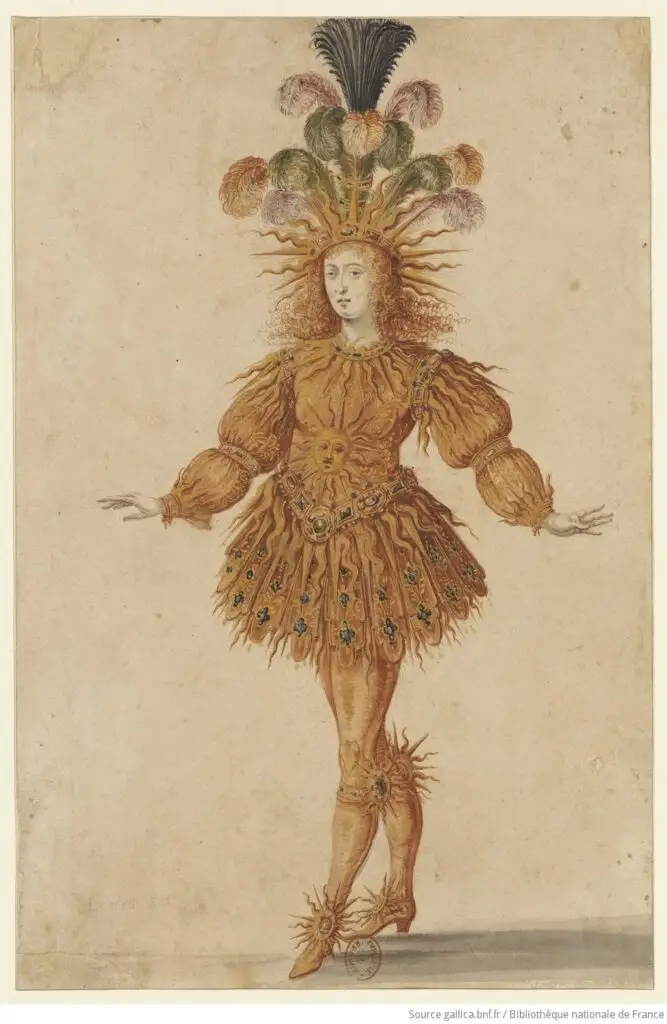
Source: Henri de Gissey, Public domain, via Wikimedia Commons.
2. Ballet was once used to train soldiers
Though dance and combat may seem worlds apart, history reveals a surprising overlap. In the 17th and 18th centuries, noblemen were commonly trained in ballet, alongside fencing and horseback riding. Ballet was considered part of a refined gentleman’s education, cultivating balance, co-ordination, discipline, and posture – all traits useful on the battlefield.
This connection persisted far beyond the aristocratic courts. During World War II, Soviet soldiers used ballet training to improve agility, discipline, and physical endurance. Today, some military veterans still turn to ballet (and related fields like Pilates) as part of physical and emotional recovery.
The similarities make sense: both dancers and soldiers depend on precision, strength, resilience, and a relentless drive to master challenging skills. As one observer put it, “When you can lift girls, you can carry weight.”
3. The audience used to join in
Modern ballet audiences are expected to sit quietly and clap only at appropriate moments. But in the earliest court ballets of the Italian Renaissance, the audience wasn’t just watching… they were dancing too.
Professional dancers didn’t yet exist, so court events blurred the line between performer and spectator. Guests often joined the choreography during the finale, creating a communal celebration rather than a staged performance.
This participatory tradition faded as ballet moved from courts to theaters, formalising into the highly trained, highly specialised art form we know today. But in its earliest days, ballet was as much a social dance as a spectacle.
4. Ballet is illegal in Iran
One of the most unusual (and least known) facts about ballet today is that it is banned in Iran. Following the 1979 Islamic Revolution, Western dance forms, including ballet, were prohibited under laws governing public morality and gender mixing. Public performances, training, and even teaching ballet are considered illegal.
Despite this, an underground dance culture persists, with dancers practicing in secret studios or private homes. Their commitment underscores ballet’s global reach… and the lengths artists will go to to preserve their art.
5. Dancing en pointe began with a flying machine
The iconic image of a ballerina balanced effortlessly on the tips of her toes did not originate from strength alone. In fact, the first pointe-like effect came from a mechanical invention.
In 1795, choreographer Charles Didelot introduced a device nicknamed the ‘flying machine’—a system of wires and pulleys that lifted dancers upwards, enabling them to rise onto their toes and glide weightlessly across the stage. Audiences loved the ethereal illusion.
Choreographers wanted more of that gravity-defying magic, and over time, pointe work evolved into a technique dancers achieved through training rather than machinery. By the 19th century, pointe shoes began to take shape, and the art of dancing en pointe became a defining feature of ballet.
Marie Taglioni’s legacy cemented the transition from mechanical illusion to true technical mastery. In 1832, her performance in La Sylphide marked the first time pointe work was used not as a novelty, but as an expressive tool that shaped a character’s identity. Taglioni trained rigorously to strengthen her feet and ankles, allowing her to rise onto pointe without visible strain, creating the floating, other-worldly quality audiences associated with the Romantic era. Her artistry set the standard for generations of dancers and transformed pointe work from a clever stage trick into a hallmark of ballerina technique.
Marie Taglioni and Antonio Guerra, 1840

Source: The New York Public Library, Public Domain.
If ballet’s stranger side has sparked your curiosity, use Stage Lark’s event directory to discover performances that could be the perfect fit for your child.