In the summer of 1518, a woman stepped into a narrow street in Strasbourg and began to dance. There was no music. No celebration. No audience. Her name, according to historical records, was Frau Troffea – and once she started moving, she couldn’t stop. Hour after hour, day after day, she danced until her feet swelled and her body collapsed from exhaustion. And then something even stranger happened: others began to join her.
Within weeks, dozens, then hundreds, of people were dancing uncontrollably in the streets of medieval Strasbourg. Some reportedly danced until they suffered strokes or heart attacks. Others died of sheer exhaustion. To this day, historians still debate what caused one of the most bizarre outbreaks in recorded history: the Dancing Plague of 1518.
Strasbourg on the brink
To understand how such a strange event could occur, it helps to understand Strasbourg itself. In the early 16th century, the city was part of the Holy Roman Empire and home to around 25,000 people. Life for most residents was harsh and uncertain. Years of poor harvests had brought famine. Diseases like smallpox and syphilis were common. Religious anxiety ran deep, fuelled by fears of divine punishment and damnation.
This was a society under intense psychological strain. People believed strongly in supernatural forces, saints, curses, and possession. Saint Vitus, in particular, was feared for his supposed ability to curse people with uncontrollable dancing. When misfortune struck, it was often interpreted not as chance, but as a sign of God’s anger.
Source: Wellcome Library, London
Dancing to their death
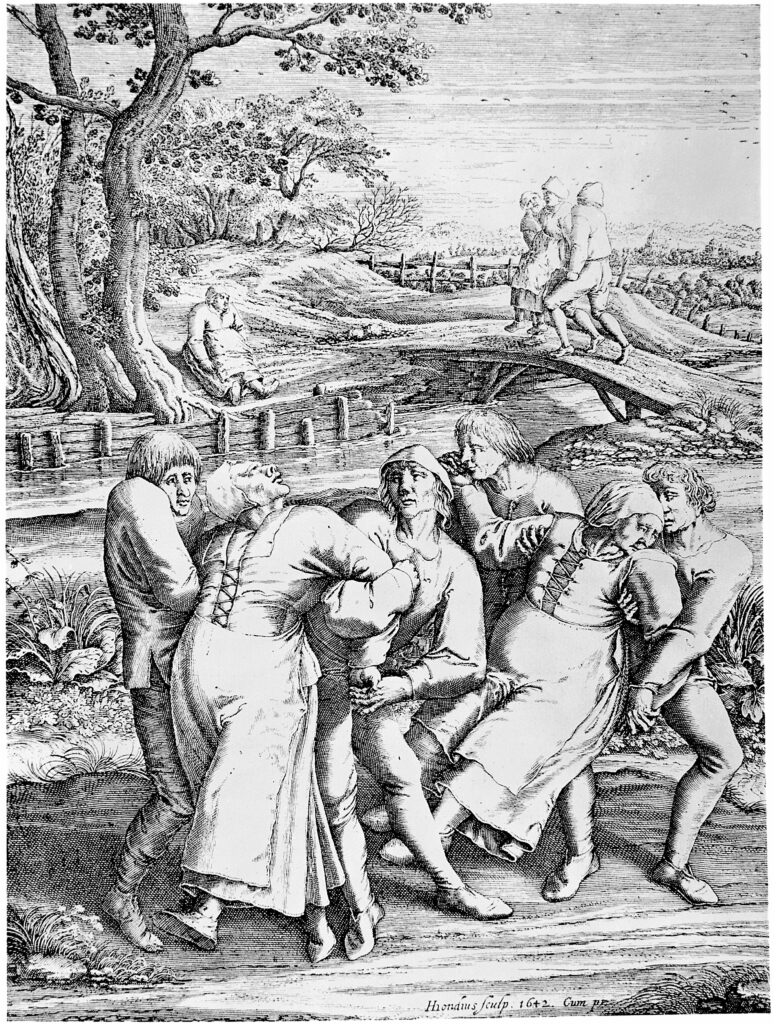
Frau Troffea’s solitary dance soon attracted attention. At first, neighbours tried to help her stop. When that failed, they watched in confusion and alarm. Within days, others began dancing as well – men and women, young and old – each unable to control their movements.
By August, contemporary accounts suggest that as many as 400 people were affected. Witnesses described dancers screaming in pain, begging for help, or collapsing unconscious, only to rise and continue moving. Some reportedly died from exhaustion, heart failure, or dehydration.
Local authorities, faced with a crisis they didn’t understand, made the strange decision to actually encourage the dancing. Believing the afflicted needed to dance the illness out of their systems, officials ordered stages to be built and musicians to be hired. Guild halls were opened so sufferers could move freely. However, rather than curing the plague, this response may have intensified it.
Witnesses described dancers screaming in pain, begging for help, or collapsing unconscious, only to rise and continue moving.
Medieval medicine and divine wrath
To the people of 1518, the dancing plague didn’t seem that random. Many believed it was a curse sent by Saint Vitus or Saint John. Others attributed it to demonic possession or moral failure. Medical theory at the time was rooted in the concept of bodily “humours”- these were imbalances that could cause illness if not corrected.
Treatments reflected these beliefs. Some dancers were taken to shrines dedicated to Saint Vitus, where priests performed rituals to cleanse them of the curse. Others were subjected to bloodletting or herbal remedies. Crucially, few questioned whether encouraging mass dancing might be making things worse! Eventually, when authorities shifted tactics and removed the music and isolated sufferers, the outbreak began to fade.
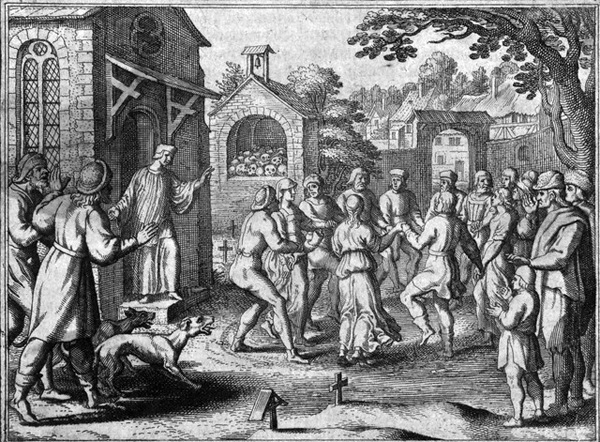
Source: Wikimedia Commons, after Pieter Bruegel the Elder (1564), engraving by Hendrik Hondius
What really caused the dancing plague?
Modern historians and scientists have spent centuries trying to explain what happened in Strasbourg. Several theories dominate the discussion:
Ergot poisoning: Ergot is a fungus that can grow on rye, a staple grain in medieval Europe, and contains chemicals similar to LSD. Ingesting it can cause hallucinations and convulsions. While a tempting theory, it has major flaws: ergot poisoning typically causes violent spasms, not coordinated dancing, and it’s unlikely to affect hundreds of people in the same way for weeks.
Mass psychogenic illness: Under extreme stress, groups of people can develop shared physical symptoms without a clear biological cause. In a society steeped in fear, superstition, and hardship, the sight of others dancing uncontrollably may have triggered a powerful psychological response – or mass hysteria.
Religious trance states: Dancing as a form of spiritual expression or possession was not unheard of in medieval Europe. In moments of crisis, these behaviours may have become amplified and detached from their original context. According to the Guinness Book of Records, the Dancing Plague of Aachen (1374) was the worst outbreak, where hundreds danced in the streets, reportedly in a semi-trance, until authorities intervened.
We still can’t fully explain it
Five hundred years later, we still don’t really know why the people of Strasbourg danced. The streets are quiet now, the music long gone, but the mystery remains – etched into chronicles and whispered through history.
Interested to read more surprising facts about dance? Read our blog on 5 of the strangest facts about ballet – covering countries that have banned the artform to bizarre flying machines on stage.